Monday, April 26, 2010

Intellectual Passions


We're coming to the end of the school year and there is still so much to do. I'd hoped that we'd be way ahead, but we aren't, so a few weeks ago we began to double up here and there to get it all done.

To my surprise, Simon hasn't complained. As a matter of fact, he's welcomed it. The presidential biographies are now devoured in one or two sittings. He has taken over reading the tales in
The American Story, even though they are at an 8.1 reading level and full of figurative speech. What was impossible in the fall is now doable. I still have to stop him to make sure he understands what it means to "view life in black and white," or that Elvis moved as if "he'd swallowed a jackhammer." But mostly Simon just reads and I listen, interrupting here and there simply to posit a question or make an observation.

Simon is older, of course. Almost a year has passed. He and his skills have matured. But he's also happily galloping through the readings because as he puts it, he's “really into” American history, the presidents in particular.

Yesterday he insisted that we go through the Netflix catalog, hunting for documentaries. And can I find him more audiobooks about American history? Furthermore, we're planning a trip to Washington, D.C. in the fall, and he's disappointed we can't go to New York as well, and Campobello Island in Maine, to track down all things FDR and Eleanor.

I sense in Simon the fetishism of the impassioned lover. He wants to see the presidential portraits, wander through the presidents' homes, and get as close as possible to the documents Dolly Madison saved when Washington was attacked in the War of 1812. He wants to gaze upon and caress (and hopefully one day read) everything that has anything to do with the objects of his affections

And nothing makes me happier. Sometimes I wonder if I'm doing the right thing, committing to tight reading schedules and ambitious curricula. “Are we reading our way through this mountain of texts for him--or for me?” I ask myself. A friend of mine once said, laughing, that my curricula for Simon bordered "child abuse."

So often it's breezy and sunny down here in Miami, especially during the school year months—we could be at the beach or traipsing through the Everglades. Instead we are indoors, on the couch, talking about the Great Depression late into the afternoon, how the opossum was imported into this country to serve as food, how people ate dogs and cats and lived under cardboard in the cesspool that became Central Park.

And then it happens. Somewhere along the year, he's hooked. So hooked I feel him drifting away from me, off in his own world, sensing what it will be like to live with him in the years to come as he slowly becomes a man full of interests, affections, and obsessions of his very own. Around this time last year it happened with world history. Every spare minute of every day was devoted to listening to the audiobook of
The Story of the World. This year it's the story of this country.

“Maybe at the library they have audiobooks about the presidents for grown-ups, Mom, and I might like them?”

"Let's find out."

As I said, nothing makes me happier. My most passionate and uncomplicated love affairs have been with books, and with some of their authors, whom I've never met, many of them female, or gay, or long dead. I count Virginia Woolf, Michel Montaigne and Roland Barthes among my dearest friends. They're always nothing but a source of pleasure, comfort, and companionship. I can come to them again and again and they never disappoint or break my heart.

I grew up in Peru with a pop-up TV the size of my hand which carried very little worthwhile programming. My parents were and are omnivorous readers, consuming 2-3 books a week. I began reading books on my own when I was eleven. I can't claim my reading was erudite—at thirteen I had read every Agatha Christie available in revolutionary Peru. Books took me away from school, from home, from my changing body, from the uncertainty that the revolution unleashed in our home, from parents who were loving but mercurial. Books provided a welcoming world that was all mine just by reading.

One of my greatest wishes for Simon is that he have intellectual passions, especially now, here, today, every day. We live in a culture governed by stuff, surrounded by people who work day and night so they can afford more stuff, who then spend their free time buying stuff, and once they have it, tending to it, perpetually tethered to it. This problem is not unique to this country. It's the complicated pleasure and the exorbitant price of affluence. It's a kind of slavery with no obvious chains, a slavery where no blood is spilled, but a slavery nonetheless.

I'm not a therapist, but I'm certain that the struggles of so many with depression, weight, and addictions have a lot to do with an abundance of stuff and an emptiness at the core of their beings. I'm always most content--and I'm not always content--when my mind is eagerly chasing down this or that idea, this or that author, recipe, painter, poet, film-maker. I feel most alive, most grateful to be here, when I'm teaching myself something new, and I don't need any stuff for that, or people for that matter. A library card will do.

Now it turns out Simon has been bitten by the same bug. I don't know exactly what I did right, other than choosing great books and making certain they were read. We have maxims in this home, one more trite than the next, but they seem to have worked their magic: Franklins don't give up; Franklins do what they say they are going to do; Franklins give their best. Simon stepped into those books, sometimes reluctantly, and doggedly week-in-week-out he read, and before he knew it fell in love, consumed by curiosity and an unrequited passion for men and women he will never meet, men and women he can only hope to bring alive, bring closer to his lips and fingertips, by reading, by learning.

Sunday, April 18, 2010

That War

Cologne, 1945
These past weeks my son has been reading me stories about that war. The book we are using, Jennifer Armstrong's The American Story, only has two: one on the Manhattan Project, and a second story on the Navajo code talkers.

"Only two stories on World War II?" said Simon, browsing through the index. "But, Mom, it lasted a long time." He knows a lot about that war from Susan Wise Bauer's The Story of the World, Vol. IV.

And he knows about it from me. Every so often, I walk by his room and hear him telling a friend of his: "My mom doesn't like war." Sometimes he adds: "My grandma and grandpa were in a war--a real war." These words are meant to explain his foreign mom's odd behavior: why she doesn't allow violent video games, why she asks that all play involving war sounds--the tuck-tuck-tuck-tuck-tuck of submachine gunfire, the whistling of bombs dropping, the kah-boom of them hitting the ground, the barking commands of officers--be kept to a minimum, or be relegated to the garden or rooms with doors.

Like Simon, I was for a moment surprised by how tangentially Armstrong treats that war. But then I remembered that she is writing for middle schoolers--kids. Furthermore, the war was not fought here, on this continent, in American cities. It was fought across at least one ocean. Too many American soldiers gave their lives, and too many families suffered the loss of fathers, sons, brothers, even sisters and daughters. But civilians, the rest of the American population, the vast majority that was not fighting, they were here, safely on the American continent. Events other than World War II are more central to the story of this country than its brief but defining engagement in stopping Hitler, and Armstrong is right in devoting the bulk of her book to them.

* * *
My first sustained contact with Americans happened when I came to college in this country. It was a good school into which I was accepted because I spoke a handful of foreign languages and had the AP scores to prove it--neither my grades nor my SATs were anything but average.

I arrived at college feeling a bit like an impostor. The other students were not eccentric but deeply accomplished; furthermore, so many seemed to come from happy-go-lucky American families that skied and played tennis. The fathers wore golf jackets or polo shirts and shook your hand with vigor, flashing teeth: "And where are you from, young lady?" The mothers were athletic and friendly and seemingly uncomplicated: "Must be hard to be so far from home." For most of them home had been one place for decades, centuries. Everything about them said that all was well with the world, that they knew deep in their hearts that all would always be just fine.

For football games in the blustery New England fall, many of the parents returned to campus with the trunks of their cars full of wine and food, which they consumed on expensive fold-out chairs in the parking lot of the football field. These were alien rituals for me. Why would you want to picnic in a parking lot in the cold? But these strange creatures, full of joy and self-assurance, wrapped in L.L. Bean, pearls and baseball caps, sat in the chairs on the gravel of the parking lot, swirled wine in plastic cups and talked about their sail-boats.

I envied them. I envied the students, the parents, the whole lot of them. It wasn't their privilege and their fancy fold-out chairs--my parents had done well for themselves, and I never lacked anything money could buy. What I envied was their happiness, their innocence, their self-satisfaction, their fearlessness--the predictability of their lives.

* * *
I'm almost fifty now and from this vantage point it seems like that war has always been with me. It was there when I was a child because it was hardly mentioned, although from time to time, especially when my grandmother came to visit, suddenly nightmarish stories would emerge en masse: air attacks, waiting in the cellar in the dark, people praying, buildings crumbling, blindness, injuries, death of fathers, hunger, more hunger, stealing food and eating rotten potatoes, more bombs, displacement to Bavaria, abuse by other kids, by teachers, by inconsolable mothers, walking to school for three hours through the rubble, soldiers doing terrible things to women, more hunger, playing in the rubble and finding hand-grenades, or the bodies of the dead, burned, or bloated, etc, etc, etc.

My parents were eleven when the war ended. Both of their fathers had died. Two stories always stood out. At eleven my father walked mostly alone from the south of Bavaria back to Berlin through occupied Germany. My mother was trapped in a collapsed building in Cologne at age nine for three days. Afterwards, she was blind for six months..

The tone when these stories were told was always utterly and completely wrong. My mother would insist when pressed as to how she had felt about any of it that it hadn't been a big deal. Nicht so schlimm. Not so bad. Lackadaisical. Tough as nails. She said that because it had been a "communal experience" she hadn't suffered much--my mother who is flooded by her own feelings almost every minute of every day, and the only thing predictable about her is that she lives trapped like a squirrel in a snare, unpredictable from constant pain. As for my father, he was always the hero in the adventures of his own making. That war was just another backdrop for the tale of his life, a grand mixture of luck and cunning. Of course, that was when he was happy. When he was not, he lay in bed and smoked cigarettes by the pack and roamed the house in the middle of the night. When he was neither very happy nor very sad, he worried his children and his wife were stealing his scissors, his ruler, his paper clips, his socks, his money, and that nothing worth while would ever be achieved by any of us. I loved them both fiercely and spent my childhood trying to anticipate their every mood and need.

* * *
I don't like living in Florida, but for Simon this house--not far from where OJ came to live when he ran out of money and moved to Miami--is the center of his universe. I might daydream of moving back to Boston and having a fireplace and neighbors who own books instead of motorcycles and boats, but there are days when I wonder if that will ever happen. I wish for Simon that mythical happy American childhood: an address that does not change, a life that is reliable, full of pleasurable rituals and a family of friends, a life he perceives as safe, a minimum of fear.

For all our reading of history, replete with mass murders and vicious iniquities, the day to day of our lives is peaceful, joyous. It is, I think, my crowning achievement: how hard I work at making every day a day so happy, a day in which we entertain the realities of war but do not live them.

On a more mundane note: we're thinking of building a sailboat. And a folding chair is a brilliant invention.

Wednesday, April 14, 2010

Articles on Education


I'm having a crazy week. For now, here are some very interesting articles on education that have appeared in various publications recently. Many promising changes are happening in the American public school system. That does not mean I want Simon attending, but I do often find myself thinking that some day soon I should take what I've learned teaching Simon and move it into a classroom, or a think tank, or a textbook publishing house. I encourage you to do the same. We all have a lot to offer.

--The The Atlantic Monthly published an article earlier this year that focuses on the research done by Teach America ("What Makes a Great Teacher? by Amanda Ripley"). The research points to specific strategies that good teachers use. Many of those strategies are discussed.

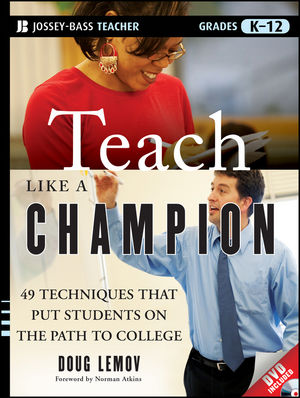
--The New York Times Magazine published an article a few weeks ago on the research done by Doug Lemov ("Building Better Teachers" by Elizabeth Green), who has studied teachers whose students perform well . Lemov came out with a book on 4/5/10 based on that research called Teach Like a Champion: 49 Techniques that Put Students on the Path to College (see above). I've bought the book and am slowly working my way through it. It's focused on teaching classrooms full of kids and it's written in a very dumbed down mannner--obviously Lemov does not think much of teachers; however, I'm finding the book very useful. Every chapter yields a new strategy, a new insight.

--This is the New York Times page on Michelle Rhee, the chancellor in charge of the DC schools. She's been shaking up that endlessly flawed and poorly performing system.

--Last month, the New Yorker published a piece on Arne Dunkin ("Class Warrior" by Carlo Rotella), the new secretary of education. I can only give you an abstact.

Monday, April 5, 2010

Interpreter of Violence


A friend keeps telling me about the varied and creative book reports her eleven-year-old son is assigned at a Jewish private school here in Miami. Their enrollment has been low these last couple of years, so she's always trying to pitch me the school. Simon would love it--small classrooms and all this creativity. She's told me that every three weeks her son has to put together a book report, usually on a Caldcott or Newberry winner at a fifth grade reading level. And yet, the reality is her son rarely has to write a book report--most of the assignments involve making a mobile about the characters, or a diorama, or a lap-book, or decorating a paper bag and then filling it with cardboard pictures of all the characters with descriptions written on the back. Her son rarely completes these creative assignment on his own. My friend helps him every step of the way after she goes out and purchases whatever art supplies are needed to put them together. Sometimes these reports eat up most of her weekend.

"You should see these projects, Claudia. They are so incredibly cute," she says to me.

We haven't done any cute and creative book reports this year. Every week Simon writes a composition on an American president. At this point in the year, they've been running 3-5 paragraphs, a full page. Last summer, when the evaluator came to review Simon's portfolio and I told her my plans for this year--lots of history and weekly reports on the presidents--she said to me: "Think about varying the writing assignments a lot. Make them fun. Don't have him doing the same thing over and over." Then she walked down the driveway toward her car, turned and waved: "Remember: variation. See you next year."

The academic year is almost up, and the paper production in this home, although extensive, has been anything but varied, or creative, or child-centered . I've asked of Simon that he do a drawing of each president--that's about as creative as it's gotten. Furthermore, we haven't been reading any grade-level Caldecott and Newberry winners because in years past, Simon either read them to me, or I read them to him, and in this manner we've read many, if not most. Fact is, the substance of the learning in this home hasn't leaned toward the innocent for quite a while.

Instead, Simon has been reading history: American history, world history, and presidential biographies. For every couple of historical achievements there seem to be a handful of bloody disasters, some of which topple forests of people, whole cities, oceans of life. For fiction and non-fiction, Simon has read books like War Horse by Micheal Morpurgo, a popular children's novel in Britain, which tells the story of the million horses that died during World War I from the perspective of a horse--that book made quite an impression on both of us. He also read a book about Pompei, another about Vietnam, and The Story of Slavery, and books like The Mozart Question, also by Morpurgo, which is set in Venice and deals with Holocaust survivors. Moreover, Simon has made his way through a handful of abridged Dickens novels, all of which provide a disturbing mix of villainy, generosity, poverty, monstrosity, murder, betrayal, utter indifference to the suffering of others.

I don't think I would get a job teaching at that Jewish private school.

These literary choices are only partially my doing. Many years ago, when my younger sister was living in London, she turned me on to the British Usborne Young Reading Series. Whenever she came to visit, she would bring a couple of Usborne readers for Simon. By the time Simon progressed to level three, the subjects had turned deadly serious: the Crusades, pirates, slavery, gladiators, Adolf Hitler, the Holocaust, the Samurai, Vietnam, the abridged Bleak House. Still, they're always an interesting read. Simon can plow through them in two days, and they provide a week's worth of conversation and research.

The literary choices are very much Simon's. They reflect his interests. Last week, he asked me if I could help him find a book on the Crimean War because from an audio book he'd learned about Florence Nightingale. We're reading about Woodrow Wilson this week. Simon wants pictures of World War I, a whole book's worth. He wants to learn more about poison gas.

"Those soldiers went blind, Mom. That stuff was horrible."

I say: "You know Simon, after that war people decided that war was truly a terrible thing. It's hard to believe, but countries don't go to war as easily as they did before World War I."

As the words leave my mouth, I'm not sure any of this is true, or that I actually believe it. But they seem the right words to say to my young son. These last months I've realized I'm not the purveyor of cute projects--of which I've done my share when Simon was younger--but something I never expected to become when I began homeschooling Simon: I am an interpreter of violence. My job day in day out is to make sure all that loss of life has meaning.

Which brings me back to writing the same-old-same-old report on a president every week. I wouldn't be writing this if I didn't worry at times that I'm doing the wrong thing. Maybe a mobile or two should be hanging from Simon's ceiling. Facetiously, I think, he could make one of the many heads chopped off during the French Revolution, which we studied a few weeks ago. Red tissue paper could trail from their necks. Silliness aside, I think I'm doing the right thing.

The writing goal for this year was to learn how to put a report together, how you organize your information and then say what you have to say in a coherent narration. It has taken eight month of doing the same thing over and over. The presidents change every week. The facts change. But the format remains the same. "Please write me a report about William McKinley," I said to Simon last week, and three days later he handed me such a thing. Last fall, stumped by how hard this was for Simon, I made a detailed worksheet for each one of these reports, breaking the assignment down sentence by sentence. Repetition leads to mastery. I'm not so sure cute projects are as effective.

A final word about repetition. So much of what is discussed in our home is carnage. For years, we couldn't get Simon to converse with us at dinner--he'd just sit there and shovel in his food. And then one evening he looked up and said: "Who was worse, Dad? Hitler or Genghis Khan?" Last week the conversation was about the story of Passover, how the Egyptians wanted to destroy the Jewish race. That conversation led to talk of Easter, which my mother and siblings celebrate (I was raised Catholic but converted to Judaism when I married George.) We talked of how Jesus wasn't the only one crucified. I reminded Simon that the Romans managed the outer edges of their empire with brutality, lining roads with crucifixions and leaving them there to rot as a warning. That same week we talked of the Crimean War and what army hospitals were like before Florence Nightingale came along. This led to taking a book about the Civil War off the shelf and looking at the pictures of field hospitals. I told him that they are so much better now, that soldiers survive the most devastating wounds.

"Mom, I don't want to be a soldier," Simon said.

Reminded constantly by my son of the fragility of life, all I know to do is to practice repetition, reassuring repetitive rituals. Meals, schooling, library, chores, play-dates, chess, piano, sailing, movie night, a big lunch on Sunday, come Monday ditto all over. The days and weeks are predictable, stable, peaceful, same-old-same-old. Somehow all that repetition adds up to safety, or so I tell myself.

Tuesday, March 30, 2010

Patriotism and Kitsch


kitsch: something of tawdry design, appearance, or content created to appeal to popular or undiscriminating taste.

Driving back from Simon's piano lesson this week, we found ourselves in the car listening to an audio book called Living Adventures from American History, George Washington,
The Hero Who Fathered America-Part I: The American Revolution by Allan and Frances Kelley.

Outside our car, the Palmetto Expressway crawled along in its congested 21st century dysfunction; inside our blue Mazda, George Washington galloped around the woods of Pennsylvania and Virginia, fighting the French, the Indians, the British, accumulating victories, lands, honors. According to the Kelleys, everything the man did led to accolades. Even when he lost a battle, he seemed to win things endlessly more valuable: the approval of other men, bear hugs and promotions.

The girl in me found myself thinking: I wouldn't have liked this dude. Between his size, his athletic abilities, his cocky self-confidence, his dancing skills, his charm with the ladies, his guns, his slaves, his rum distillery, his love of fox hunting--he reminded me of the privileged, often soused preppy jocks I met at an American college decades ago. They loudly made all the right noises in class when talking about economics or politics, but privately had trouble taking no for an answer. They acted impulsively and said and took things they shouldn't, respecting only their own kin and kind. There must be some dark details to Washington's story, I thought.

But none of that was mentioned in this narrative. The man could do no wrong. Moreover, repeatedly the narrator recounted moments in which Washington almost died. Bullets barely missed him, various of his horses were shot and buckled under him. Washington invariably survived, and surviving was able to give birth to this country.

"Mom?" Simon said from the backseat, "What would have happened if Washington had died? Maybe there would be no America? Maybe the British would have killed us all, or taxed us to death?"

I could hear anxiety in his voice. The audio book had made an impression. What would have happened to this country without a father? It is the week of Passover and the easy extinction of a whole people has been a daily topic. The Jews would have disappeared from the face of the earth if the Egyptians had killed all the newborn sons of the Jews. Similarly, if you kill the father of a nation... I could see the wheels of Simon's mind spinning.

"Don't you think," I asked tentatively, "that someone else would have been chosen to lead the militia in the Revolutionary War? Someone who would have done as a good job?"

"But that person would not have been so good, Mom. That person would not be Washington. Maybe that guy would have lost the battle of Yorktown."

"Could be. But how about this? Maybe that person would have been even better. Maybe that person would had a way of getting supplies to Valley Forge sooner. Remember all those soldiers with no food or clothes in winter? Maybe that guy wouldn't have lost New York."

"Yes," Simon said, and then he added after a long pause, "but we're so lucky Washington didn't die, right?"

"Yes, Sweetie. We're lucky."

* * *

I've wondered for weeks what all this reading about America would do for me? Would it change me in some fundamental way? Would I feel more at home here? Would my feelings about the country deepen?

After the Washington episode in the car, I found myself irritated to no end. Irritated by the Kelleys and their cheesy tale of George Washington which we had to play all the way through because Simon insisted. I was irritated by Simon, by his delight in the story and the figure of Washington, by the ease with which he welcomed this sentimental, one-dimensional version. I know--Simon is eleven. He's into historical heroes; I know that, too. I didn't say a thing. But I noted my irritation. Such sentimental drivel.

* * *

Patriotism comes hard to first generation immigrants, or so it seems to me. I am grateful to be here: the man I love and my son are here; I pay taxes and will bear arms to defend this country should it be attacked directly; I give back in many ways. But the deep passion for all things American that my son feels is foreign to me.

I've lived in other places. I know in the flesh how cheaply governments can hold the lives of its people; after Vietnam and the 5,000 already dead from the latest fiasco, this government, like so many, seems deeply flawed. Moreover, I'm full of far away places, stories, people, languages, landscapes, whole cities, a thriving parallel universe now mostly lost, but which once was all I knew, and as such will always be a source of longing. Packed tight within me is what I hold dear, what makes me different: soft boiled eggs for breakfast and grainy bread, a dozen much loved books, fresh cut flowers, meals my mother made. And I'm full of things I cannot abide. If I would have to find just one word for those things, it would be a word in German that has entered all Western languages: kitsch.

Above is an elegant dictionary definition of kitsch; however, a famous one was given by Milan Kundera in The Unbearable Lightness of Being. He was talking of kitsch as an effect of totalitarian regimes. Kitsch was all the ways in which authoritarian regimes gloss over and re-imagine the unacceptable realities of their policies. Here, at the risk of offending some of you, is Kundera's definition:

...kitsch is the absolute denial of shit, in both the literal and the figurative senses of the word; kitsch excludes everything from its purview which is essentially unacceptable in human existence.

Patriotism in all its celebratory and florid rhetorical expressions always smells of kitsch to me. I distrust it. Like that audio book of Washington, it glosses over complexity, and purges details that are unacceptable. At times patriotism can lead to great deeds--but not always.

* * *

Having probably offended you all, I should confess that some things have changed these last few months. I knew so little when Simon and I began reading. Now all these figures and events fill much of our day. And slowly many characters have taken residence in my mind, keeping me company, becoming friends of sorts. I find myself making lists of the books I will read when this is over--about Lincoln and that war, and Jefferson, and Dolly Madison, and that big book on Jackson that came out a few years ago, American Lion, and the journals of Lewis and Clark. And Washington. I must read more about Washington. And I want to do a road trip with Simon. I want to see the South West and Pittsburgh and the Erie Canal and the Colorado River.

* * *

For now, Simon has requested that we get a hold of Part II and Part III of the George Washington audio book biography. I will bite my tongue. I promised him I'll do my best.

Monday, March 22, 2010

I Had Other Plans--Notes for a Future Resume


"It's not the money, or even the time. It is simply that I had other plans."

from "On Spectrum: My Daughter, Her Autism, Our Life" by Sallie Tisdale in the April 2010 issue of Harpers Magazine. The essay deals with parenting a handicapped child well into adulthood at the expense of the mother's professional and personal plans. The essay made me think of the tough choices women make when they decide to home-educate their children and back-burner their professional life. The circumstances of homeschooling mothers are different; however, just like Sally Tisdale, many "had other plans."

In the years since I began home-educating my son, working women in my circle of family and friends have advanced in their professions from associate to partner, from teacher to assistant principal, from untenured to tenured, from unpublished to published, from little nobody to management. I think about that often as I print up math drills, correct Latin translation--Sumus poetae et estis nautae--and learn about the American presidents. And I think about it, sometimes all night long, whenever I've been in the company of someone who does not think much of homeschooling and has let me know exactly just how low their opinion is of homeschooling in general and my doing it in particular.

It always hurts. It hurts for a variety of reasons. I can never help but feel that my mental health and my love of my son are being questioned. I must be homeschooling due to an excess of narcissism and a lack of love for Simon. Better parents would make better choices.

Usually I can let those feelings go. There's nothing like homeschooling to help one learn just how conventional and careful most of the people in your life are. And scared. If they're not doing what everyone else is doing, something terrible will happen, or so they believe.

The other reason that a dismissive comment about homeschooling hurts is that I've become darn good at it, and it's what I do for many hours of every day. It's what I am--a homeschooling mom. I, too, had other plans. But for now they are on hold to teach Simon to read, to write, to add and multiply, and to keep him out of the classrooms meant for atypical children: the ubiquitous behavioral classroom, the learning disabilities classroom, the ADHD classroom, the autism spectrum classroom, the pervasive developmental disorder classroom, etc. One of those classrooms would have Simon's name on it. None of those classrooms has a commitment to preparing the kids in their care for a future that involves a profession or a trade--forget grad school. These classrooms merely exist to allow the other teachers in that school to better teach all the other children--every child but mine.

Like so many homeschooling mothers, I could have spent these last years doing something out there in the world, running something, anything: a classroom, a department, a company, an organization, a school, a small country. Instead, I've spent the time at the end of a cul-de-sac in Miami learning with my son about Perseus, percents, photosynthesis and President Lincoln.

Soon this time will come to an end. Simon will decide he really wants to go to school, because schools have girls and AP history and science fairs, or he will do high school with us while attending a community college and taking online courses. He's beginning sixth grade in the fall. Within a few years, his schooling will be an independent endeavor, whether he's home-schooled or not. I will be able to go back to work.

What do I put on my resume for this decade--this lost decade?

What follows are some very informal brainstorming notes to revisit when it's time to shape a formal resume:

I haven't killed my son.
I've gotten pretty impatient on various occasions and, when the spirit is weak, will do so again. Some things are not easy for Simon. Sometimes he doesn't get it on the first try, or the second. But over the years, I've learned that every time I raise my voice, every time my words quivers with frustration and anger, I lose him to anxiety and fear. Nothing--absolutely nothing--is accomplished with impatience. I've learned to breathe when the going gets tough. "Silly Mommy has obviously not taught you this well enough. Let's try again tomorrow." Along the way, I've learned to teach.

Note: In a future interview, be prepared to discuss in detail what it is exactly that good teachers do.

I haven't killed friends and family.
My experience has been that outside of friends who are artists, ex-teachers, or university professors, nobody has been supportive of homeschooling, although over time I've worn almost everyone down into polite silence.

Homeschooling is something poor uneducated evangelicals do who've never been to Paris or New York--why would you want to go anywhere near that? So they say.

Last summer, my father said to me: "You haven't done anything with your life."

Tough stuff.

Lonely work.

Note: Remember to weave into interview that college professors love to have homeschooled kids in their classes. Homeschoolers read novels all the way through. They actually do the assigned work. 1 out of 3 homeschooled kids who apply get accepted to first and second tier schools. The numbers for the rest of the population are 1 out of 8.

I haven't killed anyone in the homeschooling community.
Most of us spend our lives in our little cocoons among people more or less like us. Once you homeschool and take your child to a park or enrichment group, your're out there among people with whom you share very little other than a fierce commitment to homeschooling. It is hard work to find common ground if initial greetings expand into a conversation. But it can be done.

Note: For interview be prepared to tell funny stories about meeting homeschoolers. Highlight the many times your own preconceptions were wrong.

I'm still here--with a smile no less.
These have been some of the happiest years of my life. Every week I see progress. Every week my work shows results. I never feel like I'm working just for a (nonexistent) pay-check. Every action has a purpose. I can function in utter unsupported solitude for as long as there is a purpose to my work, and the work makes a difference.

I know who Procrustes is, and so much more, so don't mess with me.
I have learned and re-learned a formidable amount of information: Greek mythology, world and American history, Latin, German, math, the minutia of grammar. I can learn anything. And then I can teach it. And then I can write about it.

I'm the decider.
Most years I haven't chosen a boxed curriculum. I study what the requirements and expectations are. I go to conventions, the library, the internet. I talk to Simon. Then I decide what books we should use. The buck stops here.

If it doesn't work, I pitch it.
If I'm not happy with how much progress Simon is making, I re-evaluate. I've often made mid-course corrections, or halted our journey through a math program for many weeks to drill certain skills.

I'm flexible and willing to concede a decision I made is not working. I can keep my eye on the ball. Results matter. Teaching Simon to write essays and getting him to read 300 page books--that matters. Compliance with a plan does not.

Monday, March 15, 2010

An Unrelenting Push Forward


unrelenting
1.
not relenting; not yielding or swerving in determination or resolution, as of or from opinions, convictions, ambitions, ideals, etc.; inflexible: an unrelenting opponent of the Equal Rights Amendment.
2.
not easing or slackening in severity: an unrelenting rain.
3.
maintaining speed, effort, vigor, intensity, rate of advance, etc.: an unrelenting attack.

Reading the stories these last weeks, I'm astounded by the unrelenting speed and intensity with which all things modern transformed this country: within the span of a few decades, homes and cities were illuminated by light bulbs; roads, train tracks and a variety of wires crisscrossed the landscape; women got the vote; the White House got a telephone; New York City got the Statue of Liberty and millions of immigrants who came with new ideas, old world know-how, and the will to work hard; Texas found oil and with it fueled airplanes that went up in the air and stayed there, and cars and trucks that could get from here to there lickety split.

These last weeks Simon has found a new word: technological. All things great and wonderful are technological: youtube, computers, TVs, Legos, cellphones, anything made by Nintedo. He welcomes and celebrates every new invention and innovation we read about, understanding intuitively that electricity, oil wells, telephone wires and light bulbs have everything to do with the joy he takes in all things technological and, preferably, vaguely inappropriate. In his mind, technological and fun are linked, as are old-fashioned and lame.

I, in turn, find myself thinking of the word unrelenting. All that change came at the expense of unrelenting industriousness. The innovators changed paradigms, and then the muscle, sweat and blood of millions made those paradigms real, pushing and prodding the nation into the modern age. Nameless somebodies laid train tracks, planted telephone poles, dug ditches and road beds--a nameless multitude.

Something to think about. All that hard work. No slackers there.

I've been trying to get Simon to understand that. I've told him about my grandmother. Although of limited means and education, she had a snappy aphorism for every situation. "Von garnichts kommt garnichts," she would say in a thick Berlin accent--from nothing comes nothing. Modernity doesn't just happen. Youtube and TVs and cars and electricity don't just happen. They are the result of work--unrelenting work.

We're in that place in the school year where you assess your child's progress and begin to make plans for the next academic year. Have your child's skills improved enough? Will he be prepared for next year's demands? It hit me hard a few weeks ago: Simon is not reading well enough--for me. He gets through grade level reading comprehension assignments, as well as stories and chapter books, if I demand it or sit by his side; however, he does not do any sustained reading on his own. And it shows.

He spends hours looking at illustrated history encyclopedias and listening to audiobooks, but he's not independently picking up Harry Potter, or something much easier like The Time Warp Trio. There have been a few exceptions, a fifth-grade biography of Lincoln for example, but no matter what we bring home from the library, he will not repeat the accomplishment. He carefully looks at the chapter headings, illustrations, photograph captions, and learns a lot just from doing that, but he does not read the books all the way through.

So I did what only a homeschooling parent can do: I revamped the curriculum--from now on he has to read to me at least three hours a day, whole chapters at a time. From now until further notice no more spelling, grammar, paragraph editing, reading comprehension, science and geography. From now until further notice this child will primarily read . He will read and then, with the exception of a few subjects, he will read some more. Besides all the history assignments, he will read all five volumes of Rick Riordan's Percy Jackson and the Olympians out loud to me. It will take a few months, but it will fix the problem.

When presented with the change of plans, Simon wasn't happy.

"That's not fair! You know I don't like reading. Reading is hard for me. I love audiobooks. Audiobooks are technological. Audiobooks are modern. Books are old-fashioned and lame."

We talked for a long time. I told him that I know he learns very easily listening to audiobooks and that reading does not come that easy to him. I told him that like Percy Jackson, Simon has a touch of dyslexia. Here and there he switches letters, or suddenly reads from right to left, or transposes b and d. Welcome to the club--Mom and Dad also transpose and switch to this day. But the only way reading will get easier is practice--unrelenting hard work. From nothing comes nothing. And by choosing not to read except when he has to, he isn't getting enough practice. He's going into sixth grade next year.

He complained for a few days. It wasn't fair. It was too hard. Anxious and angry, his reading deteriorated. I wondered if I had made the wrong decision, if I was being unreasonable, unrelenting. But then Percy kills the minotaur and suddenly Simon was having fun, reading with much greater ease--he's listened to the series repeatedly on CD.

"I love this chapter, Mom. Isn't it great?"

And then technology came to our rescue. I'd done some editing work last year for a friend who surprised me over the holidays with an e-reader, a Kindle. I was delighted and bought some Alice Munro but then found I wasn't using it that much. A week ago, I paid $4.40 for a Kindle copy of Book I of Percy Jackson's adventures. I blew the text up to the max, forty words to the page, and handed it to Simon. 300% improvement. No kidding. And every day I notice it gets easier. There's greater fluency, fewer mistakes. Feeling more relaxed he tries to entertain me, doing voices, imitating the talented readers he's heard on CD. Yesterday he asked me if we can get all the books for sixth grade on the Kindle.

"This thing is very technological, Mom."

We're having fun, working hard, moving forward.

Reading List

100 True Tales From American History by Jennifer Armstrong.

Getting to Know the U.S. Presidents by Mike Venezia. This is a series. Also check out all of Mike Venezia's other incredible books at his web-site.

Simon loves The Story of the World, Vol. I- IV, by Susan Wise Bauer. He listens to the audiobooks for many hours every day. They play in the background while he fiddles with Legos or does math.


www.theexaminedlife.org

Together with Toni Deveson, Claudia was one of the founding members of www.theexaminedlife.org , a net-based home-education support group for families teaching a secular curriculum in the Miami area. Claudia remains a very active participant. The group is inclusive, welcoming families of all faiths—or lack thereof, and all life-styles. The Examined Life runs a small enrichment co-op for children in grades 4-6. This year, the co-op is covering biology, art appreciation (nine painters), music appreciation (seven composers), history—the Renaissance and beyond, and Latin. All the portfolio-ready materials that Claudia and Toni have developed themselves are available for free at www.theexaminedlife.org , including a comprehensive 36-week enrichment curriculum for the above named topics, as well as the American history project covered in this blog. The website also has a bookstore that carries all the books necessary to teach the curriculum.