Monday, January 25, 2010

Teddy Bears

Week by week, we continue to read in The American Story: stories about the building of the Brooklyn Bridge; the rebuilding of Chicago; the Johnstown flood; Ellis Island; Lizzie Borden; Mark Twain and Helen Keller; the exploding of the U.S.S. Maine; Thomas Edison; William Randolph Hearst and Joseph Pulitzer; Teddy Roosevelt and the bear cub; the brothers Wright; Prohibition; Texas' oil; the San Francisco earthquake and the ensuing fire of 1906. Of all those stories, the ones that interest Simon most are the ones that involve floods, explosions, fires and murder.

“I want to learn everything about Lizzie Borden. She was wicked,” he says. The library has one children's book about the trial. It seems to be out on permanent loan. Someone out there shares Simon's obsessions.

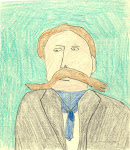
I, in turn, am smitten by a little story about Teddy Roosevelt. It's a light tangential story, slipped in between weightier, history altering events--a breezy respite of sorts.

Story goes that Teddy Roosevelt was invited to go on a bear hunt by the governor of Mississippi. After two days, Roosevelt hadn't shot a thing, so his hosts, afraid that the president would emerge from the hunt without a kill and without his dignity, presented him with a bear cub tied to a tree.

They said to him something to the effect of: “Here, Mister President. You can shoot this one pretty easily.”

Roosevelt, horrified, refused. We know that he answered: “If I shot that little fellow, I couldn't be able to look my boys in the face again.”

This story made good copy. The papers went wild. Roosevelt and the bear became symbols of compassion.

A savvy Russian immigrant by the name Michtom suggested to his wife she make a stuffed bear and maybe they could sell it in their candy shop. Within days, she couldn't keep up with the demand. Within a year, the Michtoms had founded at toy company. Everybody had to have a teddy bear.

* * *

Simon loves stuffed animals. He has dozens of them, all over his bed, in his closet, in a trunk. These days, he sleeps with his head on a polar bear and his arms around a huge fat kangaroo he recently bought for himself at IKEA. Near his head sits Sidney, the lion, who used to belong to his sister, keeping watch.

I don't know what all these stuffed animals mean to Simon. Regression, an unwillingness to grow up—there is some of that. A preference for a more merciful world, one in which the strong do not eviscerate the meek, a fanciful world where loving lions and bears guard the sleep of children —there is a lot of that.

* * *

My father had a teddy bear. At the end of the war, after his father had died, his mother and her sisters arranged for him to be sent to a school in southern Bavaria so that he would be safe from the bombs falling on Berlin. He took that teddy bear with him.

When the war ended, the school was at loose ends. They had run out of money and provisions. The kids were sent out to beg from the farmers nearby. If that didn't yield enough food, the kids stole whatever they could get their hands on. Chickens were barbequed. Dogs were slaughtered. My father was eleven. There was no way to get in touch with his mother. Railroad tracks, telephone lines, roads—everything had been destroyed.

A group of older boys at the school decided to just run away--walk home. My father was going to tag along. On the agreed upon morning, all the older boys wimped out. Father and another eleven-year-old decided to leave anyway.

600 kilometers through bombed out, occupied Germany. Along the way, American soldiers gave them some food, a coat, a place to sleep, sparking my father's great love for all things American. Eventually, the other boy and my father parted ways. Father walked on alone. He crossed a ditch full of shot SS, a pond of blood. He saw pyramids of the dead, stacked, or in flooded subway stations, bloated. He swam across a river and was shot at. Somehow he made it home to his widowed mother. The teddy bear was in his coat pocket.

* * *

I have a bear that belonged to my father. For decades, I thought that bear was the one Father had schlepped across Germany. Some years ago, he told me I had it wrong. This bear was not that bear. That bear was smaller and had been pitched way back when. It had been loved too much. It was too shabby.

The wrong bear sits in my bedroom for the last twenty-five years—see above. On one of my many visits to Berlin, my grandmother said I could have him. It sounds silly and sentimental, but he keeps me safe.

Monday, January 18, 2010

Bear Hunting

So many early American presidents were functionally illiterate into adulthood. Of the seventeen presidents we've read about thus far, a significant number learned the three Rs minimally, or late, very late: seventeen, eighteen, nineteen. The most striking examples are Andrew Jackson, James K. Polk, Zachary Taylor, Millard Fillmore, and Andrew Johnson.

Jackson was dirt poor and rarely attended the local schoolhouse. By age thirteen he'd joined the revolutionary army. Polk was terribly ill with bladder stones and didn't go to school until he was seventeen. Zachary Taylor grew up in frontier Kentucky and had to work. He was embarrassed all his life by his lousy spelling and penmanship. Millard Fillmore and Andrew Johnson worked with their folks and then became apprentices, Fillmore in a cloth factory and Johnson as a tailor. Both Fillmore and Johnson were schooled only as young adults by their wives. And then there is the example of Abraham Lincoln who, growing up in the backwoods of Indiana and Illinois, only had a few months of formal schooling throughout his life. Whatever he learned, from the classics to the law, he taught himself.

Simon's response to learning about yet another president, who as a child did not have to craft paragraphs or slog through long division, learning instead to shoot, farm, ride, hunt, sew, or fish, is always the same.

“Why do I have to do school? Forget writing—let me learn to hunt instead! Who cares about math? I'll learn how to shoot now—write later.”

He's quick to point out that he's always doing something: building Legos, making flip-books (his latest obsession) and listening to audiobooks.

“It's not like I'm super lazy, you know?”

And there is truth to that. If I'm really honest with myself, I would have to say that most of the information that Simon has thoroughly made his own, he has taught himself with a dogged persistence. I can take no credit. He listens to audiobooks of world history, replaying what he does not understand--until he does. If he's hearing about Peter the Great's siege of Azov, he takes his globe to bed and finds Azov.

I think often about these presidents not learning to read as children. We live in a culture where if a child is not mastering certain skills by a certain age, he's pronounced deficient, delayed--damaged goods. To make sure the child masters these skills at the specified time, they are reviewed and drilled year in, year out, ad nauseam. However, every home-educating parent, if brutally honest, will agree that you can teach all the math covered between 1-8 grade to a twelve year old in three months. Think of all the bears your child could have hunted, the horses he could have ridden, the wheat he could have harvested.

I'm being facetious, I know. All I'm trying to point out is that children who are not being prodded to master reading and writing skills on a strict specified schedule are not necessarily being placed in an intellectual deep-freeze. Children pursue their own interests; they yearn to be independent, to be the masters of their own lives; they make an effort to accumulate skills. Zachary Taylor, one of our greatest military leaders, became a great hunter, horseback rider and fisherman long before he reached puberty, or mastered reading. Andrew Johnson was running a business before he could write. And Abraham Lincoln, with only the most limited of formal reading instruction, read everything he could get his hands on, over and over.

We privilege formal schooling. Our (secretly) class conscious society cannot imagine substituting fishing and farming for fractions when educating a ten-year-old. How will he ever get into college? A good college? Still, not a day goes by where I do not find myself questioning the educational choices I've made.

Teaching Simon at home was the right decision--that's not where the anxiety lies. However, every day I wonder if it wouldn't be best if we closed the books and instead hunted a bear, rode a horse, harpooned a shark, dug up all of our suburban backyard and planted rows of vegetables and berries. Maybe instead of dabbling in non-academic activities, we should put them at the heart of the curriculum. Maybe we should aim at proficiency in something useful and concrete, like sailing or ship-building or farming.

Instead, I write myself a note to borrow a book on canoe-building from the library. I am a coward, bucking convention whole hog is not my thing. But I'm no fool, and I rarely fool myself. I know that if Simon backed off writing and spent a year building a canoe from scratch on the back porch while listening to audiobooks, the gains would be immeasurable. For starters, he would have a canoe, instead of a pile of papers that sooner or later will end up in the recycling bin. And if he can build a canoe from cut lumber schlepped to our house from our local Home Depot, he can do anything with his life.

For now I lack the gumption. Tomorrow we will again hit the books. As for a canoe--I'm thinking about it.

Sunday, January 10, 2010

Why I Continue Home-Educating Simon

I can't claim that I continue to home-educate Simon--now in fifth grade--because he couldn't hack a public school. Although he hates writing, and couldn't care less about math, his academic skills are more or less at grade-level. Given the right teacher and a small classroom, he would do well enough. His auditory processing skills still leave a lot to be desired: if the topic is complex and/or I fail to nab his interest, he needs lots of re-focusing and repetition. However, given a little extra attention, he gets through the material. On the up side, if he is reading an exciting novel, or discussing history, I can't shut him up, and I struggle to cajole him onto a new subject. While reading an Usborne abridged edition of a classic this week, he said: “Mom, I'm going to read Great Expectations all the way to the end and skip everything else today. OK, Mom?”

Furthermore, I can't claim that there is absolutely no school out there in this great country that would fit my exacting demands. Somewhere there is the perfect classroom for Simon. Maybe not in Miami. School might require a move. But if Simon woke up tomorrow and said he wanted to go to regular school because schools have girls, or a computer animation class, it would take a lot of work, and maybe lots of money, but George and I would find an appropriate placement. The school might not be academically challenging enough, but the library is a three minute drive away.

Finally, I can't argue that the larger home-schooling environment is throbbing with academic challenges that could never be matched by a school. Home-educators tend to organize themselves into online social networks. Once organized, members arrange for enrichment classes, field trips, and weekly social gatherings. However, with some exceptions, the enrichment classes here in Miami are fun but not demanding enough for us to leave the house; the academically challenging field trips are few and far between and, sadly, poorly attended; and, the social gatherings, usually in the form of a park group, although much enjoyed by all, have a very fluid and unpredictable quality. Families move in and out of home-educating, and they move in and out of park groups. Every time Simon gets attached to a home-educated child, it seems that child moves across town, or matriculates in the public school system, or goes to Europe for half a year.

As I write this, I have already decided on the curriculum we will be using for middle school. Simon thus far has expressed no interest in going to school—from the neighborhood kids, he's learned that schools have nasty teachers and lots of homework. For as long as he does not demand to go, George and I will not send him.

Without elaborating too much on the problems of the public school system in Florida and nationwide, what follows are the reasons why I continue to home-educate.

It boils down to two reasons—content and conversation.

I can choose the content Simon masters in one academic year. I get to do that, and not a public school teacher with 900 SAT scores (average for teachers in the US) and a mandate to teach No Child Left Behind. I can buy a curriculum and add to it, or I can make it up piecemeal. Hours and hours on the internet and at the library, and I can come up with a challenging and compelling reading list that stays as far away from textbooks and mind-numbing worksheets as possible. I can find the best foreign language program, the most enjoyable Latin course, the most appropriate history books, the right math program, art history introduction, and music appreciation teaching tool. Day by day, I try to light a fire--or two-- trying to elicit curiosity and interest in Dickens, or Lincoln, or Louis XIV, or Beethoven, or Velasquez, here and there taking a break to write a paragraph, or practice long division.

Once he has a head full of stories, full of interesting content, I can ask him to think critically about those stories, teaching him how to frame and answer questions imaginatively, always entertaining multiple perspectives. This is what it means to be educated: To have a head full of stories and facts that one can deploy imaginatively and critically.

Being home-educated, Simon has the time and the means (the curriculum I cobble together) to read and poder shelves and shelves and shelves of content. He can do it lying on his bed, at the table, at the beach, at the computer, with a friend, over cookies. It's a pretty grand way to spend the day.

The second reason I home-educate is the conversations I have with Simon. Unlike the mothers of schooled children, I know exactly what my son is reading every minute of the day—often I am the audience for his reading. If he is reading Great Expectations, we can talk about it over lunch, and some more over dinner with George. A little visit to wikipedia, and over dessert I can explain what the word Bildungsroman means. I can ask Simon to think about all the ways in which Pip grows up in the course of the novel. I can mention that Dickens wrote the novel because like Pip, Dickens' heart had been broken by a woman. I can explain the words unrequited love. We can rent the David Lean movie. We can talk about how Great Expectations compares to other Dickens Simon has already read (all abridged). We can talk about the mines, the factories, and the orphanages in England; the very poor, the destitute and the wealthy; the terrible inequities—a word I would need to define. We can get a documentary about Dickens, and then talk about that some more.

Last weekend I found myself in Boston having lunch with old friends. They asked about Simon. Would I continue teaching him through high school? I could hear in their voice their doubts about where all this might lead. My friends are the products of New England private schools and good colleges. Their daughter teaches history at a public middle school in a posh Boston suburb. I took a deep breath and said it all depended on Simon. I told them about the power of girls. I tried to make them laugh. Of late, Simon notices girls. Their hair. Their interests. Who is beautiful and nice, who is not. My best made academic plans may crumble in the face of Simon's prurient interests.

But I hope they will not. I dearly wish I can make his days enjoyable, and keep his mind turned on by ideas and concepts and texts, because I want the conversation to continue. For him. But also for me. For now, I get to read and think about Dickens and Lincoln, and unrequited love, and grave inequities. My mind and my days are hitched to work that matters.

Sunday, December 27, 2009

Gentle, Plain, Just and Resolute

We have finally reached the sixteenth president. When, at the beginning of the week, I take the Mike Venezia biography on Lincoln off the bookshelf, Simon says: “I read that already, Mom--don't you know?”

“On your own?”

“On my own.”

“Wonderful!” And then, because sometimes I have little control over my mouth, I say: “Why?” Simon reading a whole book on his own, cover to cover—that's new.

“Because it's Lincoln, Mom!” Simon says, impatiently.

“Can you read it to me again?”

“Sure.”

It's December in Miami. The windows are wide open. The air is crisp and cool. We lie on the day-bed in the Learning Room. Simon reads. I smell the grass, the trees; I hear birds. The mail-man comes up the walkway and we take a break to check if we got another holiday card. We make hot chocolate and take our mugs back to the Learning Room.

“I have to finish Lincoln all today, Mom. We cannot do Latin or German. After Lincoln, I have to read about Andrew Johnson right away. I have to find out what happened after Lincoln was shot.”

“OK. Why is Lincoln so super interesting to you, Simon?”

“Because he ended slavery. Even though he was very ugly, he was great. The presidents before him all sucked.”

“Sucked” is the new word d'jour. George and I choose our battles when it comes to colorful language. Simon can say “sucked,” but he cannot write it. We've defined formal and informal speech.

Simon finishes Lincoln, and then this child who does not read with pleasure immediately takes Johnson off the shelf and starts reading.

The Venezia biographies all begin with a general assessment. Venezia writes about Johnson that he “wasn't as skilled a leader as Lincoln had been...he was stubborn and racially prejudiced ...very little was accomplished.”

“I don't want to read anymore. Johnson sucked, too, Mom. I'll just look at the pictures. I'll read more tomorrow.”

It's a beautiful day in Miami, I think, looking out onto a Hong Kong Orchid and a Meyer's Lemon drooping with fruit. Simon lies next to me, flipping through the book.

“Look at this,” Simon says. He points to a picture of Richmond, Virginia, all rubble, all bombed out. “Why do people do that?” he asks.

Instead of saying “Why do you think?” and letting him figure it out, I proceed to do an information dump. I've been tired this week, somewhat self-absorbed. I talk of military strategy, of controlling territory, of destroying not only the enemy's cities and forts, but also his spirit.

“Did kids die in Richmond?” Simon asks.

“Some kids died, I'm sure.”

“Moms?”

“Moms, too.”

Simon is quiet. Then he says: “People are mean.” He continues looking through the Johnson biography.

I can hear the neighborhood kids congregating down the street. They are on vacation. They have a basketball. I hear it bouncing off the pavement. Soon they will come and ring the doorbell, asking for Simon.

“Mom, look at this picture,” Simon says. “Look how many people were in the room when Lincoln died.”

He's gazing at the Alonzo Chappel painting--see above. I tell Simon that I know from my readings on Lincoln that the scene is fictional. Lincoln died at a roadside inn with only a few people in attendance, not a mob of all the important political figures of the time.

“Maybe the painter wanted to show how many people would miss him,” Simon says.

“Maybe,” I say, nodding.

The doorbell rings and Simon bolts off the bed and runs out of the room. He ducks his head back in. “Can I go play?”

“Go play.”

Many people would miss him, Simon had said. I miss him.

It's been a week of too much feeling. Layered on top of the exhausting, excessive, and inescapable joyousness of the season, have been my readings about Lincoln. He never went to school; he taught himself everything, even the law. He lost two of his four sons during his life-time, all much loved. He had so many friends, they made up towns, cities, states. He cared little about all the stuff that doesn't matter: clothes, manners, appearances. Acutely aware of weight of his responsibilities, the full impact of his actions, and the full measure of his--and everyone else's losses--he struggled with melancholia.

I've poured over his key speeches. I'd never read them closely. There is something intimate, exposed, unabashedly personal about his voice, as if he's speaking to you with no reservations from the center of his heart's obsessions.

You probably remember Gettysburg and the 2nd Inaugural, but here is his Farewell Address, delivered as he was leaving Springfield, Illinois, to begin his first term. War was looming.

My friends, no one, not in my situation, can appreciate my feeling of sadness at this parting. To this place, and the kindness of these people, I owe everything. Here I have lived a quarter of a century, and have passed from a young to an old man. Here my children have been born, and one is buried. I now leave, not knowing when, or whether ever, I may return, with a task before me greater than that which rested upon Washington. Without the assistance of the Divine Being who ever attended him, I cannot succeed. With that assistance I cannot fail. Trusting in Him who can go with me, and remain with you, and be everywhere for good, let us confidently hope that all will yet be well. To His care commending you, as I hope in your prayers you will commend me, I bid you an affectionate farewell.


Lincoln has been on my mind this week. I lack his faith that “all will yet be well.” This week the Copenhagen meeting came to an end, and the Health Reform Bill went up for a vote in the Senate. How will we bring about all the radical changes we have to make for the sake of our planet, our economy, our children and grandchildren? Following the wranglings about health reform these last months, I've felt stuck in a Dickens novel—with few exceptions, each character more vain, foppish, thoughtless, reckless, and undignified than the next. I realize that the gains made by the Health Reform Bill are huge, but they seem so much less than what is necessary, a bill brokered in an age of relentless compromise, indomitable special interests, and men, mostly men, who are not Lincoln. And there are so many bills to go.

Dark thoughts in sunny Miami this holiday season.

Some last words by Walt Whitman:

This Dust Was Once the Man

This dust was once the man,
Gentle, plain, just and resolute, under whose cautious hand,
Against the foulest crime in history known in any land or age,
Was saved the Union of these States.

Monday, December 21, 2009

On the Five-Paragraph Essay and Other Instruments of Torture

(Below find Part II and Part III. For Part I go to the blog posted on Sunday 12/13/2009)

II

Simon

This year, in fifth grade, Simon is supposed to write an essay every week. First he reads a biography about an American president; then he writes an essay. I came up with this plan last spring, when full of hope and hubris I began shaping a curriculum for the coming academic year. I felt so proud of myself. Instead of doing what every other fifth grader does, namely writing a dozen book reports and a research paper or two in the course of the year, Simon would write 44 brief essays. And if he did a portrait of each president, he would have a book by year's end. Fabulous!

By July, as the beginning of the new school year loomed, I began to have doubts this grand plan was going to work. For starters, Simon has hated writing since I first handed him a pencil, and that hadn't changed. But I quickly came up with a fix: he would only have to write one paragraph a day. That seemed doable. Within five days, he would have an essay.

Then there was the problem of the topic sentence. Every one of the paragraphs Simon writes is supposed to have a topic sentence, preferably at the top, or so various writing manuals for this age group suggest.

Here, the problem was all mine. I can't stand paragraphs with a topic sentence at the top, paragraphs that begin with something like: “Abraham Lincoln was an excellent president during the years of the Civil War,” and then go on to elaborate.

This kind of writing is torturous to read, smacking of the worst of textbook prose. A topic sentence at the top of the paragraph robs the reader of the fun of making sense of what he's reading—why bother getting through the rest of the paragraph?

In lieu of the topic sentence at the top, I prefer, a snappy and opinionated sentence at the end of a paragraph, summing up and evaluating the information given in the sentences above. “Although burdened by family tragedies, doubt, and debilitating bouts of depression, Lincoln invariably rose to the demands of defending the Union.” Here is another example: “He was too skinny and quite ugly, but he was big-hearted and brilliant.”

The reader of the paragraph can then compare his conclusions, reached while reading the paragraph, to the views of the author. This makes for a dynamic and interactive reading experience. Maybe the reader agrees. Maybe not. Either way, he keeps reading.

The more I thought about teaching the essay, the more I remembered those topic sentence driven five-paragraph essays I'd had to read years ago, the ones I hadn't enjoyed—at all. The more I thought about teaching Simon, the clearer it became that I was dealing with a ten-year-old who loved narrating stories but hated writing. I wasn't going to be doing him a favor if I insisted that before he put any word on paper he first had to figure out the topic of each paragraph, and then shape a sentence about that topic. Only afterwards could he proceed with the rest of the paragraph. This was going to lead to tears and little else.

As a matter of fact, a few more sleepless nights and I decided: forget the essay. I was going to ask Simon to write reports. I would use language he comprehends. Each week he would have to report on, or tell the story of, one president. Forget five paragraphs--begin with three. Furthermore, drop the topic or thesis or analytical or opinionated sentence for now. I would get him to identify excellent topic sentences in the writing of others by asking: “What's the most important sentence in this paragraph?” But when it came to Simon's writing, I wouldn't mention it. For now.

Instead, we would focus heavily on getting the right information into each paragraph. In science Simon has spent much time learning to separate items by their characteristics, studying categories, taxonomies, animal kingdoms. For starters, Simon would focus on categorizing all the information, thinking of paragraphs merely as organizational categories.

So July ended and the school year began. The first presidential biography he read was George Washington by Mike Venezia.

“Simon, now that you have read about George Washington, you need to write a report about him. You're in fifth grade.”

“But, Mom, you're killing me--I hate writing!”

“Let's begin by writing down all the things you know about Washington. You talk. I'll write.”

He came up with eighteen bits of information.

“How could you organize all this information? How would you organize the story of this president? You can't begin your report with his death; then mention he had wooden teeth; then say he was the first president. That would be so confusing. How could you organize the information to tell Washington's story?”

“From the beginning, Mom. Don't you know? He was born in 1732.”

It took just minutes to get Simon to come up with categories. One category was going to be Washington's life before he became president. A second category was what happened once he was president. These two categories would make up his first and second paragraphs. I then urged Simon to think of a third category, something he'd learned in his reading about Washington that most people might not know. This third category would lead to a third and final paragraph.

“Think of your readers, Simon. Always think of your readers. You want to give them a reward, something extra and unexpected--a surprise--at the end of your report. It's like a treat, a yummy dessert you're offering them for patiently reading through all your words. Mom loves reading good essays because they always have something in them I did not know, or had not thought about. And that makes my mind go: Wow! What's your wow bit of information about Washington. ”

Simon was quiet for a minute.

“Well, Washington was huge, super tall, very funny. He was a good dancer, and people liked him a lot.”

I pulled out a $1.00 bill. “Does this guy look like he's funny?”

“He looks boring and mean,” and after another few seconds Simon added, “and P.S., maybe also short.”

“So, do you think your readers would be glad they read your report because they learned something new?”

“I think so.”

“I think so, too.”

That was five months ago. Last week Simon wrote an essay on Franklin Pierce, the fourteenth president. Simon wrote about how Franklin Pierce had many family tragedies: all his children died—in case you didn't know.

III

Suggestions

Ask your children to write every day. Do copy-work if writing does not come easy at first. But make sure they write. The only way to master writing is by writing.

Read. Read daily. Read good stuff. Every day, if possible, take a paragraph of something that has been read that day and take it apart. Ask questions. What is this paragraph about? How do you know? What is the most important sentence in this paragraph? Why? Is the author expressing an opinion in this paragraph, and if so, where?

Have your child tell you (narrate) what he has read. Have him tell you the story of his reading. This is an invaluable pre-writing skill. You cannot write a report on a book you read if you cannot report on it verbally.

Forget the five paragraph essay and all that comes with it—thesis statements and topic sentences. Don't introduce them until 9th grade. They will take all the pleasure out of writing.

Once your child can make it through a handful of paragraphs, have her write reports. To order the information, have her come up with categories and then write a paragraph for each category. For example, if your child is writing a book report, she would organize her report around categories such as theme, plot, character, etc. If she's writing about a historical figure or event, the categories would be dictated by chronology. If she's writing about manatees, she would categorize the information by topics: type of animal, habitat, food source, etc. If your child has thought through the categories and has a history of narrating information, she will have little trouble shaping paragraphs that will naturally have a topic sentence buried in them. Children want to tame and master the information they have learned. They demonstrate that mastery with a topic sentence. “Manatees are herbivores.” “Because of Winn-Dixie is a novel set in Florida.”

As for the essay: By 9th grade, once your child has written hundreds of reports, begin writing essays. The main difference between a report and an essay is that a report reports on a particular topic, while an essay asks a question about that topic—it is an instrument of inquiry.

Forget the thesis statement in the opening paragraph—if you give a thesis statement, there is not enough incentive to continue reading. Instead, formulate a question in your head that you want to answer. Once you have the question, begin your essay by explaining the background to your question. “Over half a million people died during the American Civil War, etc., etc.” Then ask your question: “In these pages, I would like to attempt to answer the question: Was the Civil War avoidable?” You can follow up with related questions: “Specifically, was there anything Lincoln could have done differently?” And then you proceed to answer the question. You give the historical context. You report on your research. You evaluate the information. You try to come up with an answer.

Remember that essays are attempts. You do not have to answer all the questions you raise. You can end by stating that many issues in your essay will remain unanswered. Trust me, most good essays do not completely answer the questions they raise. However, they do give their reader at least one interesting insight. This is the type of essay your child will have to write in college.

Read essays written by great essayists. There are various collections. Read essays in The New Yorker, Harpers, The Atlantic Monthly—that is where the great essayists of today publish their work.

Last words: Take it slow. If possible, write daily. Remind your kids to have fun and to create writing that is fun to read. Writing should not be torture.

Sunday, December 13, 2009

On the Five-Paragraph Essay and Other Instruments of Torture

I.

(This is the first part of what will be at least a two-part essay. Part II will be posted next week.)


I should put my academic background and prejudices on the table from the get-go. Although I now refer to myself in official documents as a “homemaker,” and otherwise I'm homeschooling my eleven-year old son at the end of a cul-de-sac in Miami, I have, in decades past, done my share of hard labor, teaching freshmen composition at colleges in the Boston area. I say “hard labor” for a reason: for the most part, I hated it.

I hated it because every two weeks I went home with a stack of essays I was supposed to read, correct, and grade, praising what had been done well, suggesting ways to make the writing better. Reading them, I would be overwhelmed by a flood of feelings: endless boredom, frustration, rage, utter indifference, utter helplessness. How was I going got get these students to write essays that I, or anyone else, might want to read?

The papers were plagued by grammar, spelling, punctuation, logic, and attribution problems, as well as a predilection for passive verbs (boring) and abstract nouns (even more boring), but those were minor issues compared to the fact that at least half of what came my way--no matter what the instructions were--were five paragraph essays.

Sometimes each paragraph had been bloated to the length of a page; sometimes the structure had been expanded to absorb ten paragraphs; but the rhetorical tool at the core of so many of these essays, whether discussing a story, a poem, or presenting a research topic was almost invariably the same—that dreadful thing taught in American schools: the five-paragraph essay.

This is what the five-paragraph essay written by too many hard-working, well indoctrinated, eager to please college freshmen reads like:

Paragraph I: Abraham Lincoln was a great president for three reasons.
Paragraph II:
Reason 1 expanded
Paragraph III:
Reason 2 expanded
Paragraph IV:
Reason 3 expanded
Paragraph V:
In conclusion, Abraham Lincoln was a great president.


The five-paragraph essay is first presented in the fourth grade. After eight years of steady practice and brainwashing, the above is what most freshmen produce: a padded, puffed-up, and self-satisfied tautology. In case you haven't reviewed your terms of logic this week, a tautology is the repetition of meaning, using dissimilar words to say the same thing twice. In brief: A equals A. Lincoln was a great president. Here are three reasons why. Therefore, Lincoln was a great president. The essay unsurprisingly ends exactly where it began.

The best of these essays would get a B-. Invariably, the recipient would make his way to my office and either livid or in tears let me know that he had been at the top of his high school class in Cleveland or Atlanta or Buffalo. He had never gotten a B-. Ever. And, Professor Franklin, Abraham Lincoln was a great president, wasn't he?

Where to begin?

When Galileo was about to be tried for heresy in Rome in 1633, he was first taken down to a dungeon and shown the instruments of torture that he would get to know better if he did not recant. So what did he do? Being a smart fellow, he gave the powers that be what they wanted.

I think of Galileo when I think of kids learning to write in an American school. By fourth grade, every one of them has been shown the instruments of torture; all of them know the price of not doing what they are told—they will be held back. Teachers “teach the test” and the five-paragraph essay, and kids learn the test and master the art of writing tautologies.

Galileo comes to mind not only because, like him, students clearly come to know the price of disobedience, but also because the five-paragraph essay has more in common with a confession induced by torture, than with the essay as it was envisioned by Cicero, Plutarch, Bacon, and Montaigne. In the five-paragraph essay, the student demonstrates (under duress) that she has been a good girl, that she has learned her lessons, that she has done her research and knows three reasons why Lincoln was a good president.

But the essay is not an instrument that is meant to perform and perpetuate indoctrination. It is, first and foremost, an instrument of inquiry. (The word “essay” actually means “attempt.”) Its present day format is very much the product of the Renaissance, a rhetorical tool that attempts to move knowledge forward in ways radical and disobedient, celebrating the individual and all that he or she is capable of. The essay might rely on what is known already, as the Renaissance painters and scholars relied enthusiastically on classical antiquity, but the thrust of the essay is into the unexplored, into new knowledge, into radical new ways of thinking and perceiving.

So what does that mean when it comes to writing and teaching the essay? For starters, forget a five-paragraph format. Forget the cookie-cutter formulations bequeathed by No Child Left Behind. If you're a homeschooling parent reading this, if you're homeschooling because you do not want your child to only “learn the test,” have the courage to also let go of the five-paragraph essay. It's not a writing instrument used by an educated and inquiring mind.

If you think that a liberal arts college might be in your child's future, realize that the first thing that will happen when he takes Comp. 101 is that some younger version of me will beat the five-paragraph essay out of him with a two-by-four, if he's lucky.

Not only will he be hurt and confused, but he will have wasted time. Instead of spending his school-years proving that he was a good boy who had done the reading, his mind could have been in training, questioning, inquiring, writing.

(To be continued.)

Sunday, December 6, 2009

What We Talk About When We Walk Around In Venice

These are the things we talk about about while walking around Venice with Simon:

~Is Venice going to drown? How can we stop global warming? Are they going to rescue the treasures? Is Miami going to dissappear into the sea? Maybe we should buy a boat.


"Our" canal--Rio dei Carmini


~Is Italy a dictatorship? Why are things so expensive? Is Berlusconi a tyrant? Why do the dinosaurs that we can buy in America in a dollar shop for $1.oo cost Euro 8.00? Are we sure Berlusconi is not a tyrant? Italy might have a revolution if toys are so expensive--in America they had a revolutionary war because of taxes.


~Why do people not like Jews? Why did they have to live in a ghetto?


George and Simon talking in the ghetto.


~Why did people come to Venice long ago? Why do Mom and Dad like coming to Venice? Why do we have to look at so many crucifixions and churches? Aren't we Jewish? Why do we have to hunt down every painting by the Bellini brothers--Gentile and Giovanni? Why does Dad like all these Madonnas painted by Giovanni Bellini? Are they really that beautiful?

~How many days until we can go home? Is our dog OK?

~How was Guiseppe Garibaldi like George Washington? In what way were Garibaldi, Washington, and Simon Bolivar similar? If you can answer that question, you get an ice-cream.

~Can I have another ice-cream?

Simon checking a picture he took of Garibaldi's statue.


~Did they ever let people out of the dungeon in the Doge's Palace? What happened to them? Why did they write on the walls? Did anyone give them a blanket?


~Why did they resettle all the glass and metal workers to Murano? It was a smart way to avoid having a great fire, like the London and Chicago fires--don't you think? Look at those cityscapes of Venice done by Carpaccio--do you see all the chimneys? In everyone of those buidings, someone was making a fire--isn't it amazing that Venice didn't go up in flames?


~Venice didn't burn, but I think it's going to drown. Don't you, Mom? Really?


~Why do we have to go to Joseph Brodsky's grave, if he was just a poet? Why is he buried in Venice, if he was Russian and lived in New York after the Russians kicked him out? Why did he love Venice so much?

~Can we have pizza for dinner?

Something we don't talk about:

How hard it is to leave.


"Our" Campo Santa Margherita, a few steps from our rented apartment.

Reading List

100 True Tales From American History by Jennifer Armstrong.

Getting to Know the U.S. Presidents by Mike Venezia. This is a series. Also check out all of Mike Venezia's other incredible books at his web-site.

Simon loves The Story of the World, Vol. I- IV, by Susan Wise Bauer. He listens to the audiobooks for many hours every day. They play in the background while he fiddles with Legos or does math.


www.theexaminedlife.org

Together with Toni Deveson, Claudia was one of the founding members of www.theexaminedlife.org , a net-based home-education support group for families teaching a secular curriculum in the Miami area. Claudia remains a very active participant. The group is inclusive, welcoming families of all faiths—or lack thereof, and all life-styles. The Examined Life runs a small enrichment co-op for children in grades 4-6. This year, the co-op is covering biology, art appreciation (nine painters), music appreciation (seven composers), history—the Renaissance and beyond, and Latin. All the portfolio-ready materials that Claudia and Toni have developed themselves are available for free at www.theexaminedlife.org , including a comprehensive 36-week enrichment curriculum for the above named topics, as well as the American history project covered in this blog. The website also has a bookstore that carries all the books necessary to teach the curriculum.